Incurred Loss vs Expected Credit Loss: What Bangladesh Bank's New Rules Mean for Classification and Provisioning
· 9 min read · Banking, IFRS 9, Credit risk, Bangladesh, Regulation
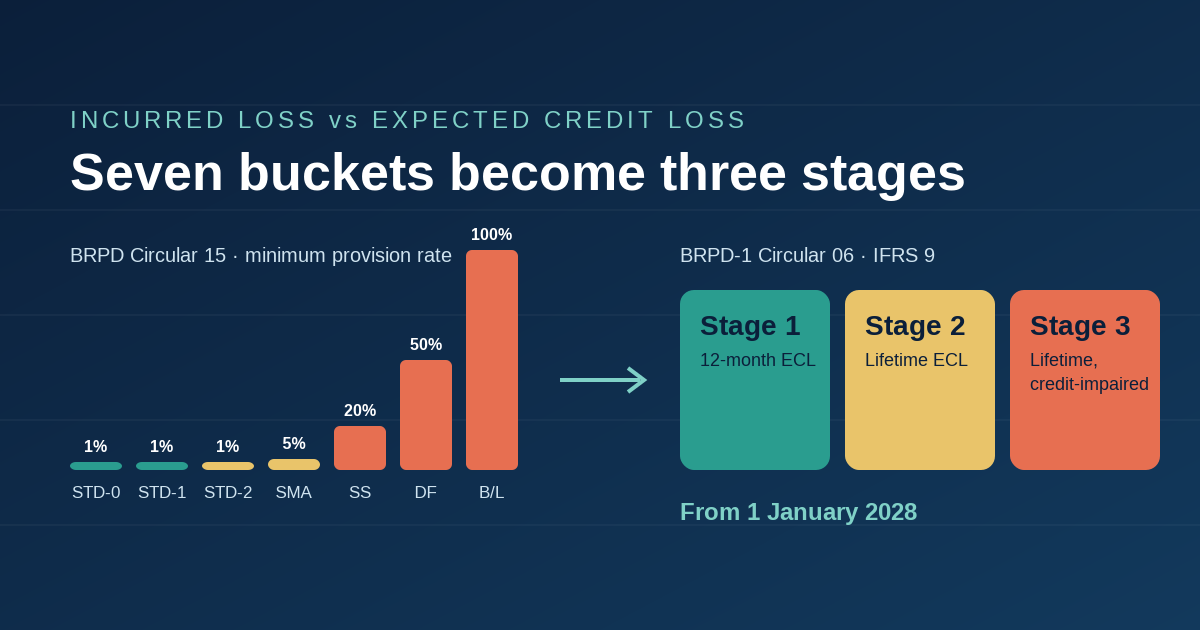
In an earlier post I gave a short introduction to expected credit loss coming to Bangladesh banks. This one goes further. I read Bangladesh Bank’s three circulars on the subject side by side, to see exactly how today’s rules differ from the expected credit loss (ECL) model and what that means for how loans are classified and provisioned.
This is my own reading as someone who works with banking data, not an official interpretation. I quote the circulars where it matters, and the sources are at the end. Read the circulars themselves before relying on any detail.
Three circulars, one direction
- BRPD Circular No. 15 (27 November 2024) is the master circular on loan classification and provisioning. It took effect on 1 April 2025 and is the rule book banks use today.
- BRPD Circular Letter No. 03 (23 January 2025) sets out the roadmap to ECL-based classification and provisioning under IFRS 9, in three phases.
- BRPD-1 Circular No. 06 (8 March 2026) issues the Guidance for banks in implementing IFRS 9 Financial Instruments. Bangladesh Bank calls it “the minimum requirements”. It applies to funded and non-funded credit facilities by January 2028, and to other financial instruments, such as investment securities, by January 2029.
- 27 Nov 2024BRPD Circular No. 15Master circular: seven categories, fixed provision rates. In force from 1 April 2025.
- 23 Jan 2025BRPD Circular Letter No. 03The IFRS 9 roadmap, in three phases.
- Mar–Dec 2025PreparationImplementation team led by the MD/CEO, a monthly database from January 2022, a pre-assessment report and staff training.
- 8 Mar 2026BRPD-1 Circular No. 06Guidance for banks in implementing IFRS 9: the minimum requirements.
- Jun–Jul 2026Framework and modelAutomated ECL model by June 2026; board-approved ECL framework to Bangladesh Bank by 15 July 2026.
- Sep 2026–Dec 2027Pilots and parallel runPilots covering 25%, 50% and then 75% of the loan portfolio, half-yearly financial statements under both IFRS 9 and existing policy, first model validation within 2027, and full implementation on a pilot basis by December 2027.
- Jan 2028Credit facilitiesECL applies to funded and non-funded credit facilities.
- Jan 2029Other instrumentsECL extends to other financial instruments, such as investment securities.
Both of the later documents describe today’s system the same way: “Presently, we are following rule-based loan classification and provisioning system.” That phrase is the clearest way into the comparison.
How it works today: a rule-based clock
Under BRPD Circular No. 15, classification starts from a clock. Each loan is placed in one of seven categories by how long it has been past due or overdue: Standard-0, Standard-1 and Standard-2, Special Mention Account (SMA), Sub-Standard (SS), Doubtful (DF) and Bad/Loss (B/L). A loan becomes non-performing at SS, which starts at three months overdue.
The clock is not the only input. Banks must also apply qualitative judgment: a loan can be classified on perceived risk even with nothing overdue, using indicators the circular lists, such as declining profitability, inadequate documentation or significant pending litigation. The final classification is “the worse one” of the objective and qualitative results.
Provisioning then follows fixed minimum rates:
- General provision: 1% of the outstanding for STD-0, STD-1 and STD-2, and 5% for SMA.
- Specific provision: 20% for SS, 50% for DF and 100% for B/L, applied to a base for provision.
The base is the outstanding balance less interest suspense and the value of eligible collateral. For most collateral it can’t fall below 15% of the outstanding, and only a share of the collateral counts: for example, at most 50% of the market value of mortgaged land and buildings.
- Outstanding balance100
- Less interest suspense-10
- Less eligible collateral (50% of land valued at 80)-40
- Base for provision: greater of 50 and 15% of 10050
SS · 20%
10
DF · 50%
25
B/L · 100%
50
The circular says these rates “are absolute minimums”, and banks are encouraged to hold more where needed. But in practice the rates do most of the work: once you know the overdue period and the collateral, the provision follows.
What ECL changes: risk since the loan was made
IFRS 9 asks a different question. Not “how long has this loan been overdue?” but “how much has its credit risk changed since we made it, and what do we expect to lose?” The answer puts each exposure in one of three stages:
- Stage 1: no significant increase in credit risk since initial recognition. The provision covers expected losses over the next 12 months.
- Stage 2: a significant increase in credit risk (SICR). The provision covers expected losses over the loan’s whole remaining life.
- Stage 3: in default or credit-impaired. Lifetime losses, and interest income is calculated on the net carrying amount.
BRPD-1 Circular No. 06 pins down the boundaries:
- Default means 90 days or more past due, or credit-impaired. For continuous loans it also covers repayments that don’t cover capitalised interest for 90 days, limits exceeded for 90 days, or limits expired for 90 days. There is a subjective test too, for exposures where full repayment is doubtful.
- SICR has a rebuttable presumption at 30 days past due. A bank that uses a later trigger has to justify it with evidence, and only in limited circumstances. Annex B lists 23 minimum indicators, from internal rating downgrades and adverse economic conditions to litigation, a deceased borrower, a borrower the bank can’t contact, missing financial statements and fund diversion.
- When in doubt, Stage 2: an exposure where the bank can’t evaluate whether credit risk has increased significantly goes to Stage 2, unless it qualifies as a high-quality asset under IFRS 9.
Here is how today’s categories line up with the stages if you look only at days past due:
Stage 1
12-month ECL
No significant increase in credit risk since the loan was made
- STD-0today 1%Not overdue
- STD-1today 1%1 day to under 1 month overdue
Stage 2
Lifetime ECL
30 days past due is the rebuttable presumption of a significant increase in credit risk
- STD-2today 1%1 to under 2 months overdue
- SMAtoday 5%2 to under 3 months overdue
Stage 3
Lifetime ECL
90 days or more past due, or credit-impaired, is default
- SStoday 20%3 to under 6 months overdue
- DFtoday 50%6 to under 12 months overdue
- B/Ltoday 100%12 months or more overdue
The circulars don’t publish a mapping like this, and it is not one. Any of Annex B’s qualitative triggers can move a loan that isn’t overdue at all into Stage 2. The mapping only shows where the two clocks agree.
The provision itself comes from a model rather than a rate table. The guidance names probability of default, loss given default, exposure at default and historical loss rates as example inputs, and says there is “no one-type fits all” model:
PD
Probability of default
Over the next 12 months in Stage 1; over the remaining life in Stages 2 and 3.
LGD
Loss given default
How much is lost if it defaults. Collateral and recoveries count here.
EAD
Exposure at default
Balance at default, including undrawn limits and non-funded facilities.
ECL
The two models side by side
What changes for classification
1. Deterioration shows up earlier. Today a loan one to three months overdue is still unclassified and carries a 1% or 5% general provision. Under ECL, 30 days past due presumes a significant increase in credit risk and moves it to Stage 2, with lifetime losses. Stage 2 is the closest thing to today’s SMA, but it is defined by the change in risk rather than by the calendar, and it carries lifetime losses: “worse than when we lent, but not yet in default.”
2. A borrower is assessed as a whole. Exposures are staged account by account, but the guidance expects banks to assume contagion. If one exposure to a borrower shows SICR or default, the rest should follow unless there is “demonstrative evidence” that contagion is highly unlikely. The same applies when credit reports show the borrower is in trouble at other banks.
3. Forbearance has consequences. Extending the term, rescheduling, grace periods, capitalising arrears or easing covenants for a borrower in financial difficulty is forbearance. A forborne Stage 1 exposure moves to Stage 2. A forborne Stage 2 exposure is tested for impairment “as if the forbearance did not occur”.
4. Orders don’t change the stage. The guidance is explicit: “Declassification of exposures by order of any competent authority does not affect the credit risk classification of exposures under IFRS 9.”
5. Upgrades take longer and need independence. Today a loan classified on the objective criteria can move to a better category once its overdue amount is paid. Under ECL, moving up a stage needs all past dues repaid in full (not through concessions), the original cause of deterioration gone, and 90 days of satisfactory performance. For forborne exposures the period is 12 months, counted after any grace period ends. Upgrades follow a board-approved policy and are carried out by a department independent of the credit review.
What changes for provisioning
1. From a rate table to a model. Stage 1 needs 12-month ECL and Stages 2 and 3 need lifetime ECL, estimated at least quarterly from the bank’s own data. Stage 2 is where I would expect the biggest difference from today’s 1% and 5%, because the provision covers the whole remaining life of the loan rather than a fixed percentage. How big depends entirely on each bank’s portfolio and data.
2. Collateral moves. Today eligible collateral shrinks the base for specific provision. Under ECL it lowers the expected loss through loss given default, but it must not be used to argue that credit risk hasn’t increased: SICR is about “the risk of default and not … the risk of loss”.
3. Non-funded exposure comes into the same model. Guarantees, letters of credit and undrawn limits sit inside the ECL framework next to funded loans, instead of under a separate circular.
4. The higher of the two, for now. Until Bangladesh Bank says otherwise, banks keep the higher of the IFRS 9 ECL allowance and the regulatory provision under BRPD Circular No. 15. If ECL is lower, the bank still books ECL, and the gap goes into a Loan Loss Reserve. That is an equity reserve funded from retained earnings, not an expense, and it can’t be distributed as dividends.
Loan Loss Reserve: 1.5
The shortfall is moved from retained earnings into a non-distributable equity reserve. It is not an expense in the income statement and cannot be paid out as dividends.
In other words, ECL can raise total provisioning but, for now, can’t take it below today’s floor. Banks must also submit a reconciliation between the two to Bangladesh Bank.
5. Interest on impaired loans. Today interest on SS and DF loans goes to an interest suspense account, and B/L loans stop accruing. Under ECL, interest on Stage 1 and 2 exposures is recognised on the gross carrying amount, and on Stage 3 exposures on the net carrying amount, after the ECL allowance.
6. Capital gets a cushion. The first-day increase in provisions reduces retained earnings, and with them Common Equity Tier 1 (CET1) capital. Banks may phase that impact in over five years by adding part of it back:
For capital purposes, ECL on Stages 1 and 2 is treated as general provision (in Tier 2 capital), and ECL on Stage 3 as specific provision (netted against the exposure when calculating risk-weighted assets).
7. Write-offs follow recoverability. A bank should write off the part of an exposure it has “no reasonable expectations of recovering”. The guidance gives the example of writing off 70% of an exposure when enforcing collateral is expected to recover no more than 30%.
What it asks of banks
The guidance spends as much space on governance as on measurement:
- A board-approved ECL framework, sent to Bangladesh Bank by 15 July 2026, reviewed at least annually, and resubmitted after each update.
- At least 5 years of historical credit data, reviewed at least quarterly. Proxies are allowed only temporarily and must be justified.
- Forward-looking information from documented, credible sources. A bank must not change sources “for the sole purpose of underreporting” ECL.
- Independent model validation at least annually, with the first validation within 2027. Validators can’t have built the model, Bangladesh Bank must be notified before they are engaged, and they report their results to Bangladesh Bank.
- Management overlays must be documented, justified and approved by the board.
- Quarterly reporting of movements in the ECL allowance between stages, and IFRS 7 disclosures.
My takeaways
The clock becomes a backstop, not the signal. Days past due still matter: 30 days for Stage 2 and 90 days for default. But the main question becomes whether risk has changed since the loan was made. That needs the risk at origination to be on record.
The floor protects provisioning, so the early impact shows elsewhere. While the “higher of” rule applies, total provisions can’t fall below today’s levels. The visible changes will be in how provisions are split between profit and loss and the Loan Loss Reserve, in capital through the Day 1 impact, and in how many loans sit in Stage 2.
This is a data project first. Five years of history, origination ratings, funded and non-funded exposures linked by borrower, collateral in usable form, and a reconciliation to the ledger. As I wrote last time, the model is the small part.
I will keep reading as Bangladesh Bank issues the further directives it mentions, on CIB reporting and reporting templates among others. If you work on ECL in a Bangladesh bank and read any of this differently, I would like to hear how.
Sources, all on Bangladesh Bank’s website:
- BRPD Circular No. 15, “Master Circular: Loan Classification and Provisioning”, 27 November 2024.
- BRPD Circular Letter No. 03, “Implementation of ECL-based Loan Classification and Provisioning under IFRS 9”, 23 January 2025.
- BRPD-1 Circular No. 06, “Guidance for banks in implementing IFRS 9 Financial Instruments”, 8 March 2026.